

TL;DR:
- Proper preparation, including budgeting and using deal apps, reduces impulse buying and saves money.
- Comparing total costs with tools and checking seller reviews ensures genuine, budget-friendly purchases.
- Post-purchase verification and record-keeping maximize value, while avoiding bulk buys for perishables.
We’ve all been there. You order something online that looked like a great deal, and when it arrives, it’s flimsy, the wrong size, or just not what you needed. Suddenly that “bargain” cost you twice as much in returns, replacement purchases, and lost time. Online shopping for practical everyday items should save you money and stress, not create more of both. The good news? With a clear plan, the right tools, and a few smart habits, you can shop online with real confidence. This guide walks you through exactly how to prepare, compare, execute, and verify your purchases so every dollar you spend works harder for you.
Table of Contents
- Prepare for practical shopping success
- Compare prices and validate offers
- Execute safe and value-focused purchases
- Verify purchases and maximize long-term value
- The overlooked realities of online shopping for practical items
- Discover practical finds for convenience and value
- Frequently asked questions
Key Takeaways
| Point | Details |
|---|---|
| Plan your purchases | Set a budget and know your needs before searching for deals to maximize value. |
| Use comparison tools | Check price trackers and incognito mode to ensure you get genuine low prices. |
| Buy safely | Pay with credit cards and track purchases for protection and long-term value. |
| Focus on cost-per-use | Evaluate items by their practical lifespan and utility, not just sticker price. |
| Avoid bulk waste | Only buy bulk if you can use or share everything, otherwise it can cost more in the long run. |
Prepare for practical shopping success
Having recognized the problem, here’s how to set yourself up for success before you even start searching online. Most people skip this step entirely. They see something, click buy, and figure out the rest later. That approach is how you end up with three sets of dish brushes and no storage containers.
The first move is to set a clear budget and rank your actual needs. Before you open a browser tab, write down what you genuinely need this week or month. Separate the “must haves” from the “nice to haves.” This one habit alone can cut impulse spending dramatically. For a deeper look at making every dollar count, our budget-friendly shopping guide breaks it down simply.
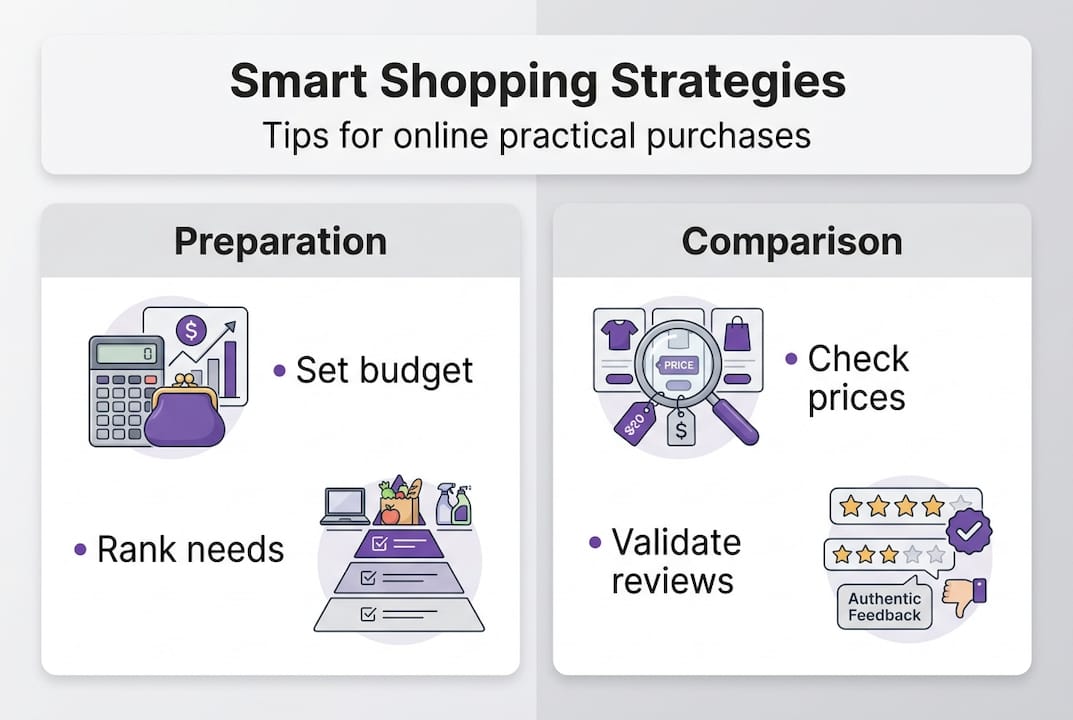
Next, think about loyalty programs and deal apps. Many shoppers ignore these because they feel complicated. They’re not. Apps like Ibotta, Fetch Rewards, and store-specific loyalty programs stack discounts you’d otherwise miss. Weekly deal tips from AARP confirm that checking weekly ads, apps, and loyalty programs and timing purchases around sales events is one of the most reliable ways to save consistently.
Here’s a quick comparison to help you decide which tools fit your style:
| Tool type | Best for | Effort level | Savings potential |
|---|---|---|---|
| Loyalty programs | Repeat purchases | Low | Medium to high |
| Deal apps (Ibotta, Fetch) | Groceries and home goods | Medium | Medium |
| Browser extensions (Honey) | One-time online buys | Low | Low to medium |
| Weekly store ads | Planned shopping trips | Low | High |
Here are the key habits to build before you shop:
- ✅ Write out your shopping list ranked by priority
- ✅ Set a firm budget per category
- ✅ Download at least one deal app or loyalty program
- ✅ Check if a major sale is coming before buying full price
- ✅ Bookmark your everyday essentials guide for reference
Pro Tip: The best sales of the year cluster around predictable dates: Black Friday, Amazon Prime Day, Labor Day, and back-to-school season. If your item isn’t urgent, waiting two to four weeks for a sale event can save you 20 to 40 percent.
Compare prices and validate offers
Once you’ve planned your purchase, the next step is to find genuine, low-priced offers online. This is where most shoppers get tripped up. A price that looks low isn’t always low once you add shipping, taxes, and handling fees. The lowest total cost including all fees is what actually matters, not just the sticker price. The FTC recommends using comparison shopping sites to get the full picture before committing.
Price trackers are genuinely underrated tools. Services like CamelCamelCamel, Honey, and Capital One Shopping let you see price history and drop alerts on Amazon and other major retailers. That means you can tell if a “sale” price is actually a sale or just the regular price with a fake strikethrough. It’s eye-opening the first time you check.

Here’s a quick look at how popular price comparison tools stack up:
| Tool | Works on | Key feature | Free? |
|---|---|---|---|
| CamelCamelCamel | Amazon | Full price history charts | Yes |
| Honey | Multiple retailers | Coupon auto-apply | Yes |
| Capital One Shopping | Multiple retailers | Price drop alerts | Yes |
| Google Shopping | Broad web | Side-by-side price compare | Yes |
Follow these steps every time you’re ready to compare:
- Search the item on at least two to three comparison sites
- Add the item to your cart to reveal the true total with shipping
- Check CamelCamelCamel or Honey for historical pricing
- Set a price drop alert if the current price feels high
- Verify the seller’s rating and return policy before finalizing
One thing most people don’t realize: retailers use dynamic pricing, meaning prices can change based on your search history. Shopping incognito prevents those price increases from following you around. Open a private browser window before you start comparing. It takes five seconds and can genuinely make a difference.
Pro Tip: Always cross-check a deal with at least two trusted sources before buying. Fake reviews and inflated “original prices” are common tactics. If something looks too good to be true, it usually is. Our guide on how to save money shopping online covers more red flags to watch for.
Execute safe and value-focused purchases
With the best deal in hand, ensure your purchases are both safe and truly practical. This is where the rubber meets the road. You’ve done the research. Now let’s make sure the actual transaction protects you.
Always pay with a credit card when shopping online. Credit cards offer buyer protection against scams, defective products, and sellers who don’t deliver. Debit cards don’t carry the same protections. If something goes wrong, a credit card dispute is your safety net. It’s one of the simplest ways to shop with peace of mind.
For perishable or consumable items, bulk buying feels smart but often isn’t. The real rule is to buy only what you can use or freeze, or split a bulk order with a friend or neighbor. Buying a 48-pack of something that expires in three months when you only use one a week is not a deal. It’s a math problem you’ll lose.
For household supplies and durables, the smarter metric is cost-per-use. A $12 mop that lasts three months costs more per use than a $30 mop that lasts two years. Concentrated cleaning formulas are a great example: they last significantly longer than standard versions and often cost less per wash. Our budget-friendly cleaning tips page has solid examples of this in action.
Here’s what to check before you click “place order”:
- ✅ Payment method offers buyer protection
- ✅ Return window is clearly stated
- ✅ Seller has verified positive reviews
- ✅ Shipping timeline fits your actual need
- ✅ Total cost (with fees) is still within budget
Bulk buying only saves money if you actually use everything you buy. For perishables especially, high waste rates can turn a seemingly great deal into a net loss. Always calculate the real cost, not just the unit price.
Want to find practical items that already pass the cost-per-use test? Check out what we’ve curated for you at Secret Finds.
Verify purchases and maximize long-term value
After you’ve completed the purchase, here’s how to make sure your order delivers lasting value. Buying smart doesn’t end at checkout. What you do in the days and weeks after matters just as much.
Start by keeping solid records. The FTC recommends that you keep records of purchases, including seller details, return policies, and shipping promises. A simple notes app or spreadsheet works perfectly. You don’t need anything fancy. Just save the confirmation email, note the return window, and write down the expected delivery date.
Here’s a step-by-step process for tracking your order after purchase:
- Save your order confirmation and receipt immediately
- Note the return window and add a calendar reminder three days before it closes
- Track the shipment using the provided tracking number
- Inspect the item on arrival, same day if possible
- Contact the seller within 48 hours if anything is wrong
Once your item arrives, run through these quick verification steps:
- ✅ Does the item match the description and photos?
- ✅ Is the quality what you expected for the price?
- ✅ Does it solve the problem you bought it for?
- ✅ Is there a warranty or registration to complete?
- ✅ Leave an honest review to help other shoppers
If you bought something that turns out not to be useful, don’t let it sit in a drawer. Sell it through Facebook Marketplace or OfferUp, or donate it. Recouping even part of the cost is smarter than letting it collect dust. Our budget-friendly daily essentials page can help you replace it with something that actually fits your life. And if you want to optimize convenience in your daily routine, we’ve done a lot of the vetting work for you already.
The overlooked realities of online shopping for practical items
The steps above are solid. But here’s what most shopping guides miss entirely.
The lowest price is not always the best deal. We say it, but we don’t always believe it when a $4.99 item is staring us down. The truth is, suspiciously cheap products often come with fake reviews, hidden shipping costs, or quality so poor you’ll replace the item in a month. Fake reviews and paid rankings on comparison sites are more common than most people realize. Always verify with multiple trusted sources.
Bulk buying is also wildly overrated for most households. Yes, it works beautifully for paper towels or laundry detergent. But for anything perishable or anything you’re trying for the first time, buying in bulk before you know you love it is a gamble. The smarter move is to buy one, test it, then stock up if it earns a place in your routine.
And the truest measure of a practical purchase? Cost-per-use. Not the sale price. Not the original price. How much does it cost you every single time you use it? That’s the number that tells you whether something was actually worth buying. Our practical savings strategies page goes deeper on this mindset shift, and it’s worth a read.
Discover practical finds for convenience and value
If you’re ready to upgrade your practical shopping game, here’s where you can find trusted value and convenience. At Secret Finds, we do the vetting so you don’t have to. Every product we feature is chosen with real-life usability and budget-consciousness in mind.

Whether you’re looking for practical kitchen gadgets that actually earn their counter space, household appliances that make daily chores faster, or home storage and organization solutions that bring real order to your space, we’ve curated options that deliver genuine value. Sign up for our newsletter and get exclusive discounts plus free shipping on qualifying orders. Smart shopping starts with the right finds.
Frequently asked questions
How do I spot fake reviews when shopping online?
Look for verified buyer badges, check for patterns in overly generic praise, and cross-reference with trusted sources like the FTC or Consumer Reports. Multiple consistent complaints are usually a reliable red flag.
What’s the best time to buy practical items online?
Major sales events like Prime Day, Black Friday, and Labor Day weekend consistently offer the deepest discounts, especially when combined with loyalty program rewards and weekly ad deals.
How can I avoid dynamic pricing when browsing for deals?
Open a private or incognito browser window before you start searching, and use price trackers like CamelCamelCamel to see the real price history before you decide.
Is bulk buying practical for home essentials?
It works well for non-perishables you use regularly, but for anything with an expiration date or anything new to you, buy small first. Wasted product erases any savings you thought you were getting.
What records should I keep after shopping online?
Save your order confirmation, note the return window with a calendar reminder, and keep the seller’s contact info handy. Tracking this information makes returns and disputes much easier to resolve.











