TL;DR:
- Effective online deal hunting requires evaluating discounts, seller reputation, and product quality.
- Avoid scams by researching sellers, verifying website URLs, and paying with credit cards.
- True value lies in long-term durability and trust, not just the lowest price.
Most people think deal hunting is simple: find the lowest price, click buy, done. But if you’ve ever scored what felt like an amazing bargain only to end up with something flimsy, delayed, or not what you expected, you already know the truth. Real savings online are about more than just a number. Online deal hunting is the strategic practice of finding discounts, coupons, promo codes, cashback, and limited-time offers to maximize what you get for every dollar. This guide walks you through exactly how it works, what traps to avoid, and how to shop smarter starting today.
Table of Contents
- What is online deal hunting and why does it matter?
- Core tactics: How smart shoppers hunt deals online
- Avoiding pitfalls: Scams and common deal hunting mistakes
- Finding real value: Comparing deals for smart decisions
- A smarter way to deal hunt: Value first, price second
- Start your deal hunting journey with curated essentials
- Frequently asked questions
Key Takeaways
| Point | Details |
|---|---|
| Deal hunting defined | Online deal hunting uses coupons, codes, and strategies to save money and increase value on everyday purchases. |
| Trust over price alone | The lowest price isn’t always the best deal—true savings come from combining value with quality and reputation. |
| Practical smart tips | Using deal forums, wishlists, and careful price comparisons makes you a more effective, safer deal hunter. |
| Scam awareness | Staying alert for fake sites, shady ads, and too-good-to-be-true offers is key for safe online deal hunting. |
What is online deal hunting and why does it matter?
Now that you’ve seen why lowest price isn’t the whole picture, let’s clarify what online deal hunting really covers.
At its core, deal hunting is a strategy, not a reflex. It means looking at the full picture: the discount, yes, but also the shipping cost, the seller’s reputation, the return policy, and whether the product will actually hold up after a few weeks. When you approach shopping that way, you stop reacting to flashy sale banners and start making decisions you feel good about later.
Here’s something worth sitting with. Price accounts for 60 to 90% of perceived value in retail, but quality and trust fill in the rest. That means the cheapest option might still leave you feeling ripped off if the product falls apart or the seller ghosts you after purchase. Experts at Wirecutter regularly flag deals that look great on the surface but were quietly inflated before the sale to manufacture a fake discount. That’s a trick worth knowing.
So why does deal hunting matter for everyday shoppers? Because small wins genuinely add up. Saving $8 here and $15 there might not feel life-changing in the moment, but over a year of consistent, smart shopping, those savings can cover a utility bill or stock up your pantry. It’s one of those habits that rewards patience.
Here’s a quick look at what separates a smart deal from a bad one:
| Factor | Smart deal | Bad deal |
|---|---|---|
| Price | Fair, verified against history | Artificially inflated then “discounted” |
| Seller trust | Established, reviewed, reliable | Unknown, few or no reviews |
| Total cost | Includes shipping and taxes | Hides fees until checkout |
| Return policy | Clear and easy | Vague or nonexistent |
| Product quality | Matches description | Overpromised, underdelivered |
“The best deal isn’t always the cheapest one. It’s the one where you got exactly what you needed, paid fairly for it, and didn’t have to fight anyone to make it right.”
When you learn to maximize savings and value by thinking beyond the sticker price, you shift from reactive shopping to intentional shopping. And that shift changes everything. You can also explore budget-friendly daily essentials to practice these principles on products you already need.
Core tactics: How smart shoppers hunt deals online
With a better understanding of what deal hunting is, it’s time to see how savvier shoppers put it into action.
The good news is that effective deal hunting doesn’t require hours of research every time you shop. Once you build a few habits, it becomes second nature. Here’s a practical step-by-step approach that budget-conscious shoppers use to consistently save more:
-
Join community deal forums. Sites like Slickdeals and Reddit’s r/deals are goldmines. Real shoppers post, verify, and vote on deals, so you get community-vetted offers instead of relying on a retailer’s own marketing. If a deal is fake or expired, someone usually calls it out fast.
-
Set price alerts 20 to 40% below current prices. Tools like CamelCamelCamel for Amazon or Google Shopping alerts let you set a target price and get notified when something drops. This takes the pressure off and lets you wait without obsessing.
-
Calculate the real price every time. The formula is simple: price plus shipping minus discounts equals what you actually pay. A $30 item with $12 shipping and no coupon might cost more than a $35 item with free shipping and a 15% code. Do the math before you click.
-
Use wishlists strategically. Add items to your wishlist and wait. Retailers often send targeted discounts on items you’ve saved. Plus, waiting a few days helps you avoid impulse purchases you’d regret.
-
Time your purchases. Major sales events like Black Friday, Cyber Monday, and end-of-season clearances are predictable. If you can wait, you often can.
-
Stack your savings. Use a cashback browser extension like Rakuten or Honey on top of a sale price and a promo code. Layering discounts is one of the fastest ways to stretch your budget.
Pro Tip: Before buying anything over $20, spend 90 seconds searching the product name plus “coupon” or “promo code” in a new browser tab. You’d be surprised how often a working code shows up that shaves another 10 to 15% off.
These smart shopping strategies work across categories, from household tools to health supplements. And if you want a deeper look at the methods, there are solid tips for saving money online that go even further into each tactic.
Avoiding pitfalls: Scams and common deal hunting mistakes
But hunting for deals can come with risks if you don’t know what to watch out for, so here’s how to stay safe.

Not every “deal” is what it claims to be. Some of the most convincing traps are designed to look exactly like legitimate sales, and they’re everywhere right now. The Better Business Bureau has reported a surge in fake store closing ads flooding social media, with scammers advertising 80 to 90% off to lure shoppers to fake websites. Once you hand over your payment info, the product never arrives and your money is gone.
Here are the warning signs to watch for:
- Prices that seem impossibly low. If a $200 item is listed at $19, that’s not a deal. That’s a red flag.
- Fake urgency. Countdown timers and “only 2 left” messages are often manufactured to push you into a fast decision.
- Unfamiliar URLs. Scam sites often misspell brand names or use odd domain endings. Always double-check the address bar.
- No HTTPS. If the site doesn’t have a padlock icon and “https” in the URL, don’t enter any payment details.
- Vague or missing return policies. Legitimate sellers are transparent about how returns work.
Scam stat to know: The FTC and BBB both warn that social media fake deals are among the fastest-growing forms of online fraud, especially during holiday seasons.
Pro Tip: Before buying from an unfamiliar seller, search their name plus the word “scam” in Google. If there are complaints, they’ll show up fast. It takes 30 seconds and can save you real money and stress.
Always pay with a credit card when possible. Credit cards offer fraud protection that debit cards and wire transfers simply don’t. If something goes wrong, you have a much easier path to getting your money back.
You can find more shopping tips for 2026 that include safety checks, and if you’re buying health products specifically, these safe shopping guides are worth bookmarking. For everyday purchases, practical essentials strategies can also help you shop with more confidence.
Finding real value: Comparing deals for smart decisions
Once you’re avoiding common traps, it’s crucial to ensure your deals really deliver on value, so here’s how to weigh your options.
Not all discounts are created equal. A 40% off tag means nothing if the original price was inflated, the product breaks in a month, or the seller has a 2-star rating. Real value comes from looking at the whole picture, not just the percentage badge on a product image.
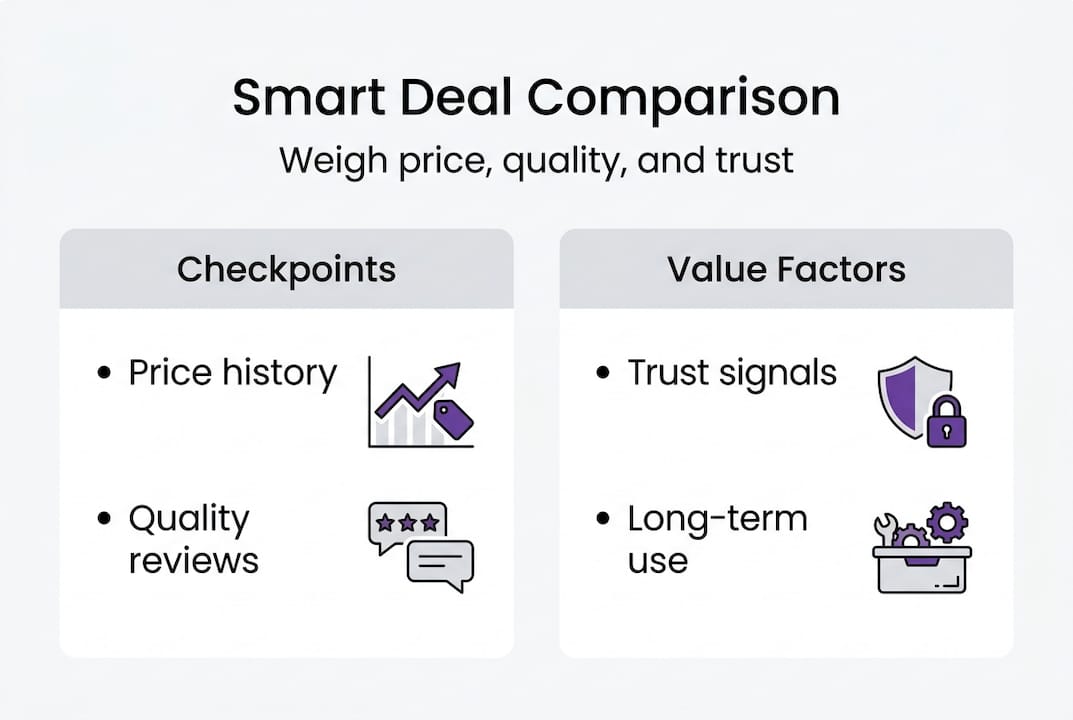
Here’s a comparison framework you can use before any purchase:
| What to check | Why it matters | How to do it |
|---|---|---|
| Price history | Reveals if the “sale” is real | Use CamelCamelCamel or Google Shopping |
| Seller reputation | Protects against scams and poor service | Check reviews on multiple platforms |
| Product reviews | Confirms quality matches the description | Read the 3-star reviews for honest takes |
| Total cost | Shows the real price you pay | Add shipping, subtract discounts |
| Return policy | Reduces risk if the item disappoints | Look for clear, hassle-free terms |
As noted earlier, price alone covers 60 to 90% of perceived value, but the remaining gap is filled by trust and quality. That gap matters more than most people realize.
One thing experienced deal hunters do that beginners skip: they think about long-term use. A $15 broom that falls apart in three months costs more over a year than a $25 broom that lasts two years. The upfront price is just the starting point. Factor in durability, how often you’ll use the item, and whether it solves the problem you actually have.
Another smart move is to read the middle-of-the-road reviews, the 3-star ones. Five-star reviews can be incentivized, and one-star reviews are sometimes from people who had a bad day. The 3-star reviews tend to be the most honest and balanced. They’ll tell you exactly what the product does well and where it falls short.
When you discover useful products through a value-first lens, you stop chasing discounts and start building a home full of things that actually work.
A smarter way to deal hunt: Value first, price second
Here’s an honest truth that took me a while to accept: I used to be obsessed with the lowest price. If I could save $3 by choosing the cheaper option, I did it every time, no questions asked. And I ended up with a drawer full of things I stopped using after a week.
The shift happened when I started asking “is this worth it?” instead of “is this cheap?” Those are very different questions. A product that costs a little more but lasts longer, works better, and comes from a seller I trust is almost always the smarter buy. It’s like the difference between filling your gas tank with the cheapest fuel available versus the grade your engine actually needs.
Chasing the lowest price can also make you vulnerable. When price is your only filter, scammers have an easy job. They just post a number lower than everyone else’s and wait. But when you add quality, reputation, and returnability to your checklist, the fake deals fall away quickly.
The best deal hunters I know treat shopping like a small investment decision. They ask: what am I getting for this money, and will I still feel good about it in three months? That mindset, combined with practical tactics, is what leads to real wins. If you want to apply this to your health and wellness purchases specifically, this smart shopping for health guide is a great place to start.
Start your deal hunting journey with curated essentials
You’ve got the knowledge now. You know how to spot a real deal, avoid the traps, and compare options like a pro. The next step is putting it into practice with products that are already curated for value.

At Secret Finds, we do a lot of the legwork for you. Whether you’re looking at health supplements savings like omega-3 fish oil or oregano oil softgels, browsing household appliances deals for practical home tools, or just trying to maximize your savings across everyday essentials, we’ve built a place where the value is already baked in. Sign up for our newsletter and unlock exclusive discounts plus free shipping on qualifying orders.
Frequently asked questions
What does online deal hunting actually involve?
Online deal hunting means strategically finding and using discounts, coupons, and promo codes to save money when shopping online. It goes beyond price-checking to include evaluating seller trust, total cost, and product quality.
How do I avoid scams when deal hunting online?
Research sellers, verify website URLs, read a mix of reviews, and use credit cards for protection. The BBB warns that fake store closing ads and too-good-to-be-true offers are among the most common traps, and the FTC echoes this warning especially around the holidays.
What are the best sites for finding online deals?
Community forums like Slickdeals and Reddit are great for community-vetted deals, while retailer newsletters, price alert tools, and cashback extensions also offer strong options for consistent savings.
How do I know if a deal is actually worth it?
Compare total price after shipping and discounts, check item quality, and weigh the deal against product reviews and store reputation. Remember that price is just 60 to 90% of perceived value, so trust and quality fill in the rest.