TL;DR:
- Many shoppers end up spending more despite subscription discounts due to increased purchasing volume.
- Stacking coupons, cashback, and discounts can lead to significant overall savings, sometimes up to 33%.
- Regularly auditing subscriptions every three months helps maintain value and prevents unnecessary stockpiling.
Subscription shopping services sound like a dream. Sign up, set your deliveries, and watch the savings roll in automatically. But here’s the uncomfortable truth: many shoppers who subscribe to save money end up spending more than they did before. It sounds backwards, but it happens all the time. The good news? When you understand how these programs actually work, you can flip the script entirely. This article breaks down the real math behind subscription discounts, shows you exactly where the savings live, and gives you the tools to make these programs work for your wallet instead of the retailer’s bottom line.
Table of Contents
- How shopping subscriptions work—and who really benefits
- What discounts and savings can you unlock?
- Practical pros and cons: How subscriptions help (and hurt) your wallet
- Smart strategies: How to maximize subscription savings and avoid common traps
- Our take: The simple audit test for subscriptions (and why most shoppers avoid it)
- Ready to save? Discover practical essentials and smart subscription deals
- Frequently asked questions
Key Takeaways
| Point | Details |
|---|---|
| Layered savings add up | Combining subscription discounts with coupons and cashback can boost your total savings significantly. |
| Review subscriptions often | Check for price changes and unused stock every few months for the best value and least waste. |
| Pick the right products | Subscriptions work best for essentials you use predictably and buy regularly. |
| Stay active, not passive | Active management and periodic audits are key to making subscriptions work for your budget. |
How shopping subscriptions work—and who really benefits
To understand if subscriptions really save you money, let’s look at how they are structured and who truly benefits.
At the core, most shopping subscription models fall into two camps. The first is auto-ship or recurring delivery, where you set a product to arrive on a schedule, like every 30 or 60 days, and get a discount for committing. Amazon Subscribe & Save is the most well-known example. The second is paid membership, where you pay an annual or monthly fee (think Amazon Prime or Walmart+) in exchange for perks like free shipping, exclusive deals, and early access to sales.
Subscription services like Amazon Subscribe & Save offer 5 to 15% discounts on recurring purchases of home and health essentials. That range matters. You get 5% for subscribing to one to four items in a single delivery, but that jumps to 15% when you bundle five or more items together. It’s a tiered system designed to reward loyalty and volume.
Who benefits most? Honestly, high-frequency shoppers buying predictable essentials like vitamins, cleaning supplies, or paper goods see the biggest wins. If you’re buying the same products month after month anyway, locking in a discount makes obvious sense.
But here’s where it gets interesting for retailers. They love subscriptions because of something called consumer inertia, which is the tendency to keep paying for something even after the value fades. Subscriptions also guarantee predictable revenue and encourage shoppers to consolidate their buying on one platform.
The data tells a revealing story. Dual subscribers average $110 per retail transaction compared to just $58 for non-subscribers. That’s nearly double the spend. So while you’re saving 15% per item, you may be buying far more items than you would otherwise. It’s worth asking: are you saving money, or just spending it more efficiently?

Here’s a quick look at how common subscription models compare:
| Model | Example | Cost | Core benefit |
|---|---|---|---|
| Auto-ship discount | Amazon Subscribe & Save | Free to join | 5-15% per item |
| Paid membership | Amazon Prime | ~$139/year | Free shipping, exclusive deals |
| Paid membership | Walmart+ | ~$98/year | Fuel savings, grocery perks |
The smartest shoppers treat subscriptions as a tool, not a habit. If you want to maximize savings and value, you need to understand the mechanics first.
What discounts and savings can you unlock?
Now that you know how subscriptions function and who they’re best for, let’s break down exactly what deals and savings you can earn.
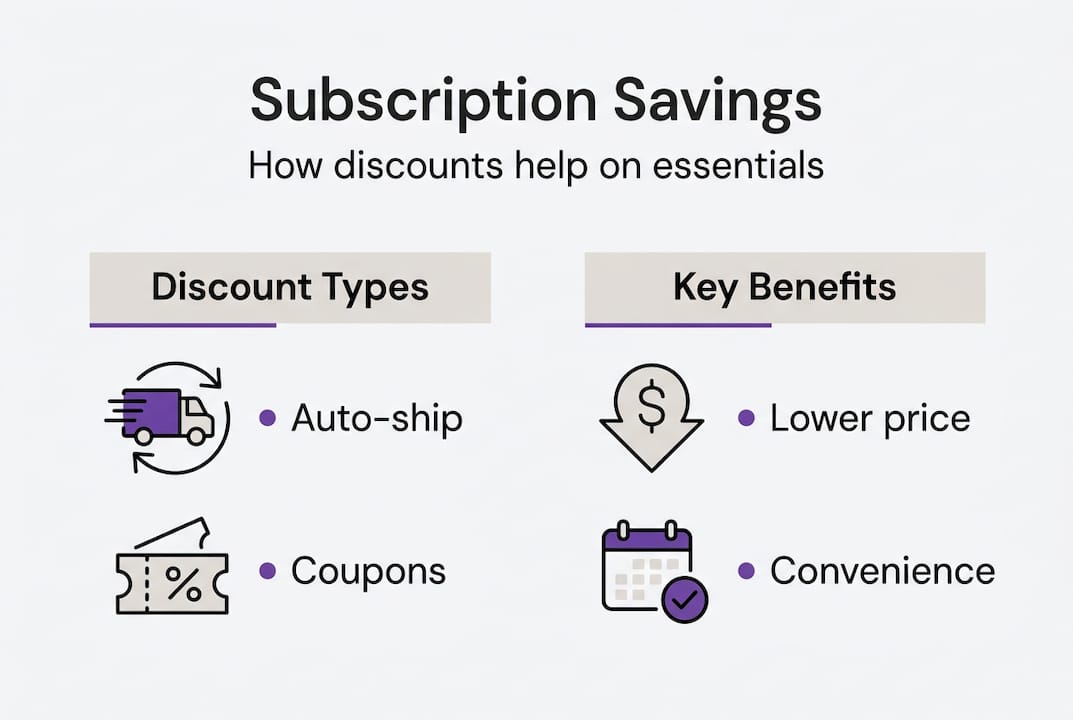
The base discount structure is straightforward. Subscribe to one to four items in a single delivery window and you get 5% off. Subscribe to five or more items and you unlock 15% off everything in that delivery. That extra 10% sounds small, but on a $200 monthly essentials order, it adds up to $20 saved every single month.
But the real magic happens when you stack your savings. Here’s how layering works in practice:
- Start with your subscription discount (up to 15% with five or more items)
- Apply manufacturer coupons available directly through Amazon or Walmart’s coupon portal
- Use a cashback credit card that rewards grocery or general merchandise purchases (often 2 to 5% back)
- Activate cashback apps like Rakuten or Ibotta for additional rebates on select products
When you layer all of these together, stacking discounts can yield up to 33% effective savings on your total order. That’s a genuinely significant number on everyday items like fish oil softgels, cleaning sprays, or paper towels.
And more shoppers are catching on. Dual Prime and Walmart+ subscriptions doubled between 2021 and recent years, jumping from 12% to 24% of shoppers, with paycheck-to-paycheck households leading the trend. They’re using both platforms to layer perks and capture the best price on every category.
Pro Tip: If you only have three or four items you genuinely need, add one or two low-cost, frequently used items (like a small pack of batteries or a travel-size soap) to push your delivery over the five-item threshold. That extra 10% discount will more than cover the cost of the filler items.
Here’s a practical savings comparison for a $150 monthly essentials order:
| Strategy | Discount | Monthly savings |
|---|---|---|
| No subscription | 0% | $0 |
| Basic subscribe (1-4 items) | 5% | $7.50 |
| Max subscribe (5+ items) | 15% | $22.50 |
| Stacked (sub + coupon + cashback) | Up to 33% | ~$49.50 |
Exploring daily essentials that save money is a great starting point, and pairing that with budget health buying tips gives you an even stronger foundation.
Practical pros and cons: How subscriptions help (and hurt) your wallet
While the potential for savings is real, it pays to know both sides of the coin.
Let’s start with the genuine wins. Subscriptions are genuinely great at a few things:
- ✅ Hassle-free reordering — no more running out of vitamins or dish soap mid-week
- ✅ Consistent discounts — your price is locked in at the moment you subscribe
- ✅ Mental load reduction — one less thing to remember every month
- ✅ Predictable budgeting — you know what’s coming out of your account
But the downsides are real too, and they’re sneaky. Subscriptions can lead to stockpiling when your delivery frequency doesn’t match how fast you actually use a product. You end up with a closet full of shampoo you won’t touch for six months. Worse, prices can creep up without any notification, meaning you might be paying more than you were six months ago without realizing it.
“The best deal is the one you actually use. A 15% discount on something you don’t need is still 85% wasted.”
There’s also the warehouse club comparison worth making. Sometimes Costco or Sam’s Club beats subscription pricing on bulk staples, especially for large households. Don’t assume your subscription is always the cheapest option without checking.
The biggest hidden trap? Subscription inertia. Consumer inertia can double seller revenues as subscribers keep paying long after the value has faded. Retailers know this. They count on it. The moment you stop actively managing your subscriptions, you shift from being a smart shopper to being a passive revenue source.
Pro Tip: Set a calendar reminder every three months to log in and review all active subscriptions. Check the current price against what you originally subscribed at, check your stock at home, and ask yourself honestly: do I still need this at this frequency?
Learning to avoid subscription pitfalls and using practical money-saving strategies keeps you in the driver’s seat.
Smart strategies: How to maximize subscription savings and avoid common traps
The smartest shoppers make their subscriptions work for them, not the other way around.
Here’s a step-by-step approach to building a subscription setup that genuinely saves money:
-
Choose the right items first. Focus on products that are non-perishable, used at a predictable rate, and purchased repeatedly. Think omega-3 capsules, laundry pods, or paper towels. These are your subscription sweet spots.
-
Audit every three months. Subscriptions excel for predictable recurring needs but require quarterly reviews to stay valuable. Check prices, check your inventory, and adjust delivery frequency if you’re accumulating excess.
-
Master the stacking system. Combine your subscription discount with available coupons, then pay with a cashback card. Run the numbers before each delivery window to make sure you’re still getting the best deal.
-
Stay nimble. Most platforms let you pause, skip, or cancel individual deliveries without penalty. Use this feature freely. If you’re traveling for a month or already have plenty of stock, skip the delivery. Don’t let convenience become a trap.
-
Use the filler strategy. If you’re sitting at four items and want to hit the 15% discount tier, add a low-cost item you’ll genuinely use. Even a $3 sponge pack can push you over the threshold and save you significantly more on the rest of your order.
Pro Tip: Keep a simple notes app list of your active subscriptions, the price you started at, and the date you subscribed. Compare it against the current price every quarter. A slow 3% price hike every few months adds up to a meaningful difference over a year.
For more ideas on saving money shopping online and shopping practical items smartly, we’ve got you covered with guides built specifically for budget-focused shoppers.
Our take: The simple audit test for subscriptions (and why most shoppers avoid it)
Beyond tactics, here’s what really separates winning subscribers from regretful ones.
Honestly? Most people avoid auditing their subscriptions because it feels like homework. And retailers are banking on exactly that feeling. The brands and platforms that profit most from subscriptions are the ones whose customers never look twice at their order history.
We’ve seen it play out repeatedly: shoppers who run a simple quarterly audit consistently save more and live with less clutter. They catch the slow price creep. They cancel the subscriptions that outlived their usefulness. They stay in control. Meanwhile, the set-and-forget crowd quietly funds retailer profits without realizing it.
The audit doesn’t have to be complicated. Fifteen minutes every three months is enough. Log in, check your active subscriptions, compare prices, look at your stock, and make adjustments. That’s it. Shoppers who do this consistently are the ones who actually win with subscriptions.
If you want to get more from your routine without overspending, start with optimizing daily convenience through practical, affordable products that genuinely earn their place in your home.
Ready to save? Discover practical essentials and smart subscription deals
If you’re ready to turn advice into action, here’s how to save more and shop smarter today.
At Secret Finds, we curate practical, affordable products designed to make your everyday life easier without draining your wallet. Whether you’re stocking up on health supplements online or browsing self-care accessories that actually get used, every pick is chosen with budget-conscious shoppers in mind.

From omega-3 softgels to home cleaning tools, our catalog is built for the kind of smart, intentional shopping this article is all about. You can also explore our shop home appliances section for practical household finds at prices that make sense. Subscribe to our newsletter for exclusive deals and free shipping offers, and start putting these strategies to work today.
Frequently asked questions
Do shopping subscriptions really save money in the long run?
Yes, subscriptions can lead to meaningful savings when used for recurring essentials, but they require regular review. Audit quarterly to catch price hikes and avoid stockpiling products you don’t need.
What are the best types of items to subscribe to for discounts?
Items with regular, predictable usage like vitamins, cleaning supplies, and pantry staples offer the best value. Subscriptions excel for predictable recurring needs where you know exactly how fast you’ll go through a product.
How do I avoid overbuying or missing out on better deals?
Review your delivery frequency and current prices every few months, compare against warehouse clubs or sale prices, and pause your subscription when you already have excess stock. Frequency mismatches cause stockpiling more often than shoppers realize.
Do all shopping subscriptions stack savings with coupons or cashback?
Not every program allows full stacking, but many do support combining subscription discounts with coupons and payment rewards. Stacking subscriptions with coupons and cashback can push your effective savings up to 33% on eligible orders.
Is Walmart+ or Amazon Prime better for budget shoppers?
Walmart+ has a lower annual fee and stronger grocery savings, while Amazon Prime offers a broader range of perks. Walmart+ appeals to grocery-focused shoppers while using both platforms together maximizes overall value for frequent buyers.