TL;DR:
- Switching to daily value products can save families up to 1600 dollars annually without compromising quality.
- Store brands often contain the same ingredients and meet the same safety standards as name brands.
- Blind taste tests frequently favor value products, which can be healthier and tastier options.
Most people assume that a lower price tag means a lower-quality product. It’s one of those beliefs that feels so logical, it rarely gets questioned. But here’s the thing: switching to daily value products can save a typical family up to $1,600 a year, and the products often perform just as well or better than the name brands sitting right next to them on the shelf. This article breaks down what daily value products really are, how they compare on quality and nutrition, and exactly how to make the switch work for your home, pantry, and personal care routine.
Table of Contents
- Understanding daily value products: What they are and why they cost less
- Quality, taste, and nutrition: How value products compare to name brands
- Beyond food: Daily value savings in home and personal care essentials
- Maximizing your savings: Everyday strategies for using value products
- Smart shopping in 2026: What most guides miss about value products
- Discover even more ways to save and simplify your life
- Frequently asked questions
Key Takeaways
| Point | Details |
|---|---|
| Same quality, lower price | Daily value products often match or exceed name brands in quality while costing 20–60% less. |
| Significant annual savings | Families can save $1,000–$1,600 a year by switching most staples to value brands. |
| Blind taste test wins | Value products frequently score as well or better than name brands in taste tests. |
| Safe and regulated choices | Household and self-care value items use the same ingredients and safety standards as leading brands. |
| Smart strategies matter | Combining label reading and flexibility helps you confidently maximize savings every shopping trip. |
Understanding daily value products: What they are and why they cost less
To make smart shopping decisions, let’s first unpack what daily value products really are and why they’re easier on your wallet.
Daily value products, often called store brands or private labels, are items sold under a retailer’s own label rather than a manufacturer’s brand. Think of the cereal on the bottom shelf with the grocery store’s logo on it. Same ingredients, same box size, but a noticeably smaller price. These aren’t mystery products made in a back alley. Many are produced in the exact same factories as the name brands you already trust.
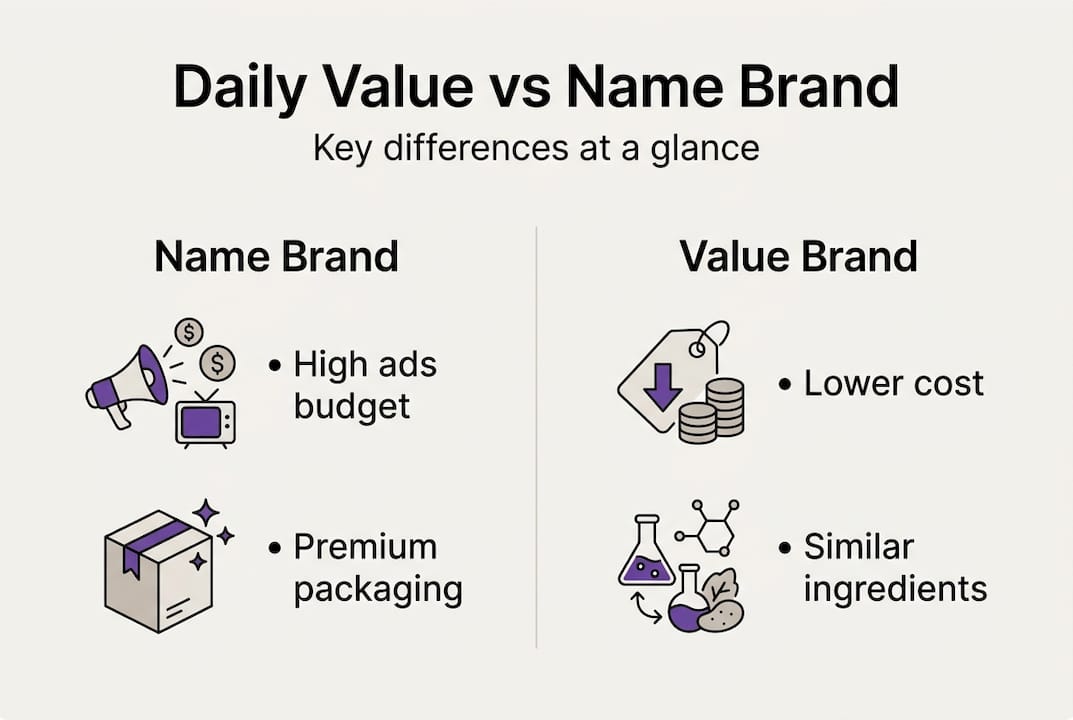
So why the price difference? It comes down to a few simple things. Name brands spend enormous amounts on advertising, celebrity endorsements, and slotting fees (the money they pay retailers just to get shelf space). Daily value products skip all of that. Retailers also use streamlined supply chains and don’t need to fund massive marketing campaigns. Those savings get passed directly to you. That’s why daily value products are 20-60% cheaper than name brands across most categories.
Here’s a quick comparison of where the money goes:
| Cost factor | Name brand | Daily value brand |
|---|---|---|
| Advertising spend | High | None or minimal |
| Slotting fees | Yes | No |
| Packaging design | Premium | Functional |
| Manufacturing | Same factory (often) | Same factory (often) |
| Final price to you | Higher | Lower |
The store vs name-brand savings can really add up when you look at it category by category. And when you explore budget-friendly daily essentials, you start to realize just how many products qualify.
Some common myths worth busting:
- “Value brands cut corners on ingredients.” Not true. Retailers must meet the same food safety and labeling standards.
- “They taste worse.” Blind taste tests say otherwise (more on that next).
- “They’re only for people who can’t afford better.” Actually, savvy shoppers of all income levels use them intentionally.
If you want a full shopping guide to maximize savings, it helps to know which categories offer the best value switches. Spoiler: it’s most of them.
Quality, taste, and nutrition: How value products compare to name brands
Now that you know why daily value products cost less, let’s judge how they stack up in your kitchen and pantry.
This is where things get genuinely surprising. When researchers and food journalists do side-by-side comparisons, nutrition profiles are comparable, with value products often showing similar sugar and fiber content and sometimes even lower salt and fat than their name-brand counterparts. That’s not a small thing. Lower sodium and fat in your everyday staples can quietly make a real difference over time.
And the taste? Here’s where it gets fun. Blind taste tests show store brands are sometimes outright preferred, with 73% of testers choosing the store-brand frosted wheat cereal, and a value ice cream beating Haagen-Dazs in a head-to-head test. Yes, really.
Let’s look at a quick nutrition snapshot for a common product like breakfast cereal:
| Nutrient | Name brand (per serving) | Value brand (per serving) |
|---|---|---|
| Sugar | 12g | 11g |
| Fiber | 3g | 3g |
| Sodium | 210mg | 180mg |
| Protein | 3g | 3g |
The numbers are nearly identical. Sometimes the value option is actually the healthier pick.
“Value-range products are no longer the poor relation of the supermarket shelf. Many now match or beat premium options on nutrition, and some are genuinely tastier.” — Food journalist, Daily Mail review of supermarket value ranges
Here’s how to compare value vs. name brands at the shelf, step by step:
- Pick up both products. Don’t just look at the price.
- Flip to the nutrition label. Compare sugar, sodium, fat, fiber, and protein per serving.
- Read the ingredient list. Shorter is often better. Look for recognizable ingredients.
- Check the serving size. Sometimes they differ, which skews the comparison.
- Note any certifications. Both can carry the same organic or non-GMO labels.
For products to optimize convenience without compromising nutrition, this label-reading habit becomes second nature fast. And if you’re curious about specific categories like cereal, the brand name vs generic cereal comparison is a real eye-opener.
Beyond food: Daily value savings in home and personal care essentials
But daily value doesn’t stop with food. Your cleaning cupboard and bathroom offer even more opportunities.

This is honestly where the savings can feel the most satisfying. Cleaning products, over-the-counter medications, laundry detergents, and personal care basics like shampoo or hand soap are all areas where value brands genuinely shine. The reason is straightforward: value cleaning and personal care products use the same regulated active ingredients as name brands, per FDA requirements. A generic ibuprofen tablet has the exact same active ingredient at the exact same dose as the branded version. Full stop.
The same logic applies to cleaning sprays, dish soap, and laundry detergent. The active cleaning agents are regulated and standardized. You’re mostly paying for the label when you go name brand. And store-brand quality has only improved in recent years as retailers invest more in their private labels.
Here are the best switches to make right now:
- OTC medications (pain relievers, antacids, allergy pills): Identical actives, fraction of the cost.
- Cleaning sprays and dish soap: Same regulated formulas, often the same manufacturer.
- Laundry detergent: Look for the same enzyme types on the label.
- Shampoo and conditioner: Great value options exist, especially for everyday use.
- Paper products (paper towels, toilet paper): Quality has improved significantly.
- Pantry staples (flour, sugar, canned goods, pasta): Virtually no difference.
Now, are there times to spend more? Yes. If you have sensitive skin and rely on a specific dermatologist-recommended formula, stick with it. Specialty personal care items with active skin-contact ingredients are one area where personal preference and skin chemistry matter. But for the everyday basics? Switch with confidence.
Pro Tip: When shopping for personal care or cleaning products, flip the bottle and read the active ingredient list. If it matches the name brand, you’re looking at the same product for less. Use this as your guide to everyday essentials and you’ll never overpay for basics again.
Maximizing your savings: Everyday strategies for using value products
With the facts and myths addressed, here’s how you can start maximizing those savings every week.
The average annual family savings from switching to daily value products lands between $1,000 and $1,600, which works out to 20 to 35 percent of the typical grocery and household bill. That’s a real number. That’s a vacation, an emergency fund boost, or just a lot less stress at checkout.
Here’s a step-by-step approach to making the transition feel easy:
- Start with one category. Don’t overhaul everything at once. Begin with pantry staples like pasta, canned tomatoes, or flour.
- Do a home blind taste test. Serve both versions to your family without labels. Let the results speak for themselves.
- Track your savings. Keep a simple note on your phone. Even $10 saved per trip adds up to $500 a year.
- Expand gradually. Once you’re comfortable with food, move to cleaning products, then personal care.
- Involve your household. Share the savings goal with your family or roommates. When everyone’s on board, it sticks.
- Revisit your list seasonally. New value products launch regularly. What wasn’t available last year might be great now.
Pro Tip: Run a blind taste test at home with your most skeptical family member. Put the value brand in an unlabeled bowl next to the name brand. More often than not, they’ll pick the cheaper one or call it a tie. It’s a fun experiment and a powerful way to break the habit of brand loyalty.
For more practical money-saving strategies that go beyond just switching brands, there’s a lot of ground to cover. And if you’re shopping online, these online shopping tips can stack even more savings on top of your value brand choices.
Smart shopping in 2026: What most guides miss about value products
Having covered strategies and evidence, let’s pull back and address what truly sets successful value shoppers apart in 2026.
Here’s something most shopping guides won’t say out loud: the biggest barrier to saving money isn’t price or availability. It’s pride. There’s a lingering stigma around value brands that goes back decades, rooted in a time when store brands really were lower quality. That time has passed. 99% of households now buy some store brands, and experts openly call value products tastier and healthier than they’ve ever been.
Brand loyalty is a habit, not a decision. And habits cost money without always delivering value. The shoppers who come out ahead are the ones who stay flexible, try new things, and let their own experience guide them rather than a logo on a package.
Blind taste testing isn’t a gimmick. It’s genuinely the fastest way to reset your assumptions. And once you’ve done it a few times, you stop seeing the name brand as the default and start seeing it as just one option among many. That mental shift is worth more than any coupon.
For fresh product discoveries for budget shoppers, the landscape in 2026 is honestly exciting. Retailers are investing more in their private labels than ever before, and the quality gap has all but closed in most categories.
Discover even more ways to save and simplify your life
Ready to start making your budget work harder? Here’s where to find more essentials that make saving easy.
At Secret Finds, we’ve done the hunting for you. Whether you’re looking for health supplements savings on everyday wellness staples, browsing affordable household appliances that actually hold up, or exploring budget beauty and self-care options that feel like a treat without the price tag, we curate products that deliver real value.

Every item on Secret Finds is chosen because it solves a real problem, saves real money, or makes daily life a little easier. Sign up for our newsletter and get access to exclusive discounts and free shipping on qualifying orders. Your next hidden gem is waiting.
Frequently asked questions
Are daily value products as safe and regulated as name brands?
Yes. Home, personal care, and food value products meet the same safety and labeling standards as name brands, and OTC meds share identical actives required by the FDA. Many are made in the same facilities.
How much can I realistically save by switching to value products?
Switching most grocery and household items to value brands can save $1,000 to $1,600 per year for a typical family, which equals 20 to 35 percent of the average grocery bill.
Do value products taste as good as premium or name brands?
Blind taste tests show daily value products are often indistinguishable from or even preferred over name brands, especially in categories like cereal, canned goods, and frozen desserts.
Are there specific things I shouldn’t buy as daily value products?
Most basics are safe and smart to switch. However, some people prefer name brands for taste-critical or skin-contact items like specialty personal care products or unique flavor profiles.
How can I compare the nutrition in value products versus name brands?
Check the label. Nutrition profiles match or exceed name brands in most categories, with value products often showing lower sodium and fat per serving.