

U.S. online supplement sales hit $16.8 billion in 2023, growing 15.4% in a single year. That’s not a niche trend. That’s millions of everyday shoppers deciding the pharmacy shelf isn’t their only option anymore. But with that growth comes a real question: is buying health supplements online actually safe, or are you gambling with your health to save a few dollars? I’ve been there, staring at a product page wondering if the deal is too good to be true. This guide cuts through the noise. We’ll look at the real savings, the real risks, and the practical steps that let you shop smarter without second-guessing every click.
Table of Contents
- The rise of buying health supplements online
- Biggest benefits: Why smart shoppers go online
- Safety, risks, and how to protect yourself when buying online
- Cost comparison: Online vs. in-store and what costs to watch
- How to buy health supplements online safely and affordably
- A smarter way forward: What most shoppers miss about online supplements
Key Takeaways
| Point | Details |
|---|---|
| Online supplement buying is booming | More shoppers are choosing online stores for convenience, variety, and deals. |
| Risks can be managed | Stick to trusted sources, check testing, and verify dosages to shop safely. |
| Understand true savings | Online deals and subscriptions can lower costs, but always factor in shipping and compare prices. |
| Apply smart shopping steps | Follow a simple checklist to buy health supplements safely and affordably online. |
The rise of buying health supplements online
If you feel like everyone around you is ordering supplements from their phone, you’re not imagining it. The shift toward online supplement shopping has been one of the fastest-moving trends in consumer health. Online now accounts for 21.3% of the global supplement market, and that share keeps climbing.
The numbers behind this are striking. 44% of UK supplement buyers now purchase online, and U.S. online sales jumped 15.4% to $16.8B in 2023 alone. Meanwhile, 61.4% of U.S. adults now use supplements regularly, and online is the fastest-growing channel to reach them.
So who’s actually driving this? It’s not just young, tech-savvy shoppers. Older adults looking for convenience, busy families trying to simplify their routines, and health-focused individuals who want access to a wider range of products are all part of this wave. The appeal makes sense when you think about it.
Here’s why so many people are choosing online over in-store:
- ✅ Shop any time, from anywhere without driving to a store
- ✅ Access hundreds of brands that local stores simply don’t carry
- ✅ Read real customer reviews before committing to a product
- ✅ Compare prices instantly across multiple retailers
- ✅ Get direct access to deals, bundles, and subscription discounts
For smart shopping for supplements, the online space genuinely opens doors that brick-and-mortar stores can’t match. The variety alone is worth exploring, especially if you’re looking for specific dosages or niche formulas. And when you pair that with the ability to find budget-friendly essentials without leaving home, it’s easy to see why this trend isn’t slowing down.
Biggest benefits: Why smart shoppers go online
Knowing the trend is one thing. Understanding why it works for your wallet and your routine is what actually helps you decide.
The most obvious win is selection. Online stores carry far more brands, dosing options, and specialty formulas than your average pharmacy or big-box store. Whether you need a high-potency vitamin D3, a specific omega-3 ratio, or a vegan collagen alternative, chances are you’ll find it online before you find it on a shelf.

Then there’s the price factor. Online subscriptions can save 5 to 10% compared to one-time purchases, though shipping costs can chip away at that. Flash sales, loyalty programs, and bundle deals add more opportunities to stretch your budget.
Here’s a quick look at how annual costs can compare:
| Purchase method | Estimated annual cost | Potential savings |
|---|---|---|
| In-store, full price | $186 | Baseline |
| Online, one-time purchase | $170 | ~$16 |
| Online, subscription | $155 | ~$31 |
| Online, subscription + free shipping | $142 | ~$44 |
Beyond price, the transparency of online shopping is a real advantage. You can read hundreds of verified reviews, check ingredient lists in detail, and research a brand before you buy. That’s harder to do standing in a store aisle.
Other practical benefits worth noting:
- ✅ Home delivery saves time and transportation costs
- ✅ Easy reordering with auto-ship options
- ✅ Access to money-saving tips for online shopping and coupon codes
- ✅ Better ability to save money on essentials through stacking deals
Pro Tip: Before subscribing to any supplement auto-ship program, check the cancellation policy. Some programs are easy to pause or cancel, others are not. Read the fine print before you commit.
Safety, risks, and how to protect yourself when buying online
Here’s where things get real. Online supplement shopping has genuine risks, and ignoring them is how people end up with products that don’t work or, worse, cause harm.
The biggest concern is product integrity. The risk of counterfeit or adulterated products is higher online, and some marketplaces sell supplements at dangerously high doses. Mislabeling is also a known issue, where a product claims one ingredient amount but contains something different.
Dose is a serious issue. Research found that online marketplaces sell vitamin D3 at up to 12.5 times the recommended safe limit. That’s not a minor overage. At those levels, vitamin D toxicity is a real risk, causing nausea, kidney damage, and worse.
Worth remembering: A low price tag on a supplement isn’t always a bargain. Sometimes it signals a product that cut corners on quality, testing, or dosing accuracy.
Here’s how to protect yourself, step by step:
- Buy from established retailers with a track record and clear contact information
- Check for third-party certifications like USP or NSF on the label or brand website
- Compare the dose on any product to government-recommended upper limits
- Read ingredient lists carefully and watch for proprietary blends that hide exact amounts
- Avoid suspiciously cheap products from unknown sellers on open marketplaces
| Reputable retailer | Risky marketplace seller |
|---|---|
| Clear brand name and contact info | Anonymous or vague seller profile |
| Third-party tested (USP, NSF) | No certifications listed |
| Doses within safe limits | Doses far above guidelines |
| Transparent return policy | No returns or unclear terms |
| Verified customer reviews | Few or suspicious reviews |
For products like fish oil, where quality really matters, checking omega-3 fish oil safety tips before buying is a smart move.
Pro Tip: If a supplement doesn’t list the exact amount of each ingredient, that’s a red flag. Proprietary blends can hide underdosing or overdosing of key compounds.
Cost comparison: Online vs. in-store and what costs to watch
Let’s talk real numbers. The mean annual supplement cost burden for older adults ranges from $142 to $186, depending on how and where they shop. Online savings of 5 to 10% sound appealing, but shipping fees can quietly erase that advantage.
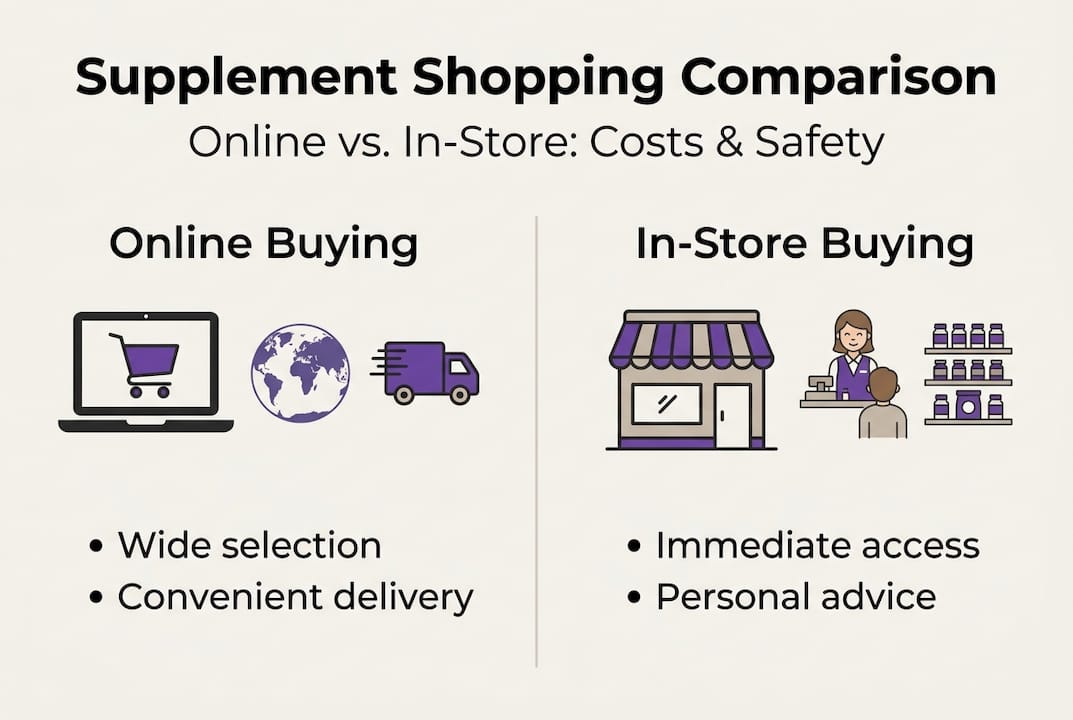
Here’s a side-by-side breakdown:
| Cost factor | Online | In-store |
|---|---|---|
| Base product price | Often 5-15% lower | Standard retail price |
| Shipping | $0 to $10 per order | None |
| Subscription discount | 5-10% off | Rarely available |
| Impulse add-ons | Easy to avoid | Harder to resist |
| Price comparison | Instant | Manual effort |
The math usually favors online, but only if you’re intentional. Here’s where hidden costs sneak in:
- Shipping fees on small orders can wipe out your savings entirely
- Auto-ship programs sometimes charge more than advertised after the first order
- Bundle deals can push you to buy more than you actually need
- Flash sales create urgency that leads to impulse purchases
The smartest move is to consolidate orders. If you’re buying multiple supplements, ordering them together from one retailer often unlocks free shipping thresholds. That’s where the real savings live. A good budget shopping guide can help you map out a monthly supplement budget that actually holds.
How to buy health supplements online safely and affordably
Okay, you’ve got the full picture. Now here’s the practical checklist that pulls it all together.
Prioritize reputable sites with third-party testing, check dosing carefully, and consult a healthcare specialist if you’re managing any conditions or taking medications. That’s the foundation. Here’s how to build on it:
- Research the brand first. Look for a real website, customer service contact, and a history of third-party testing.
- Check certifications. USP and NSF are the gold standard. These mean an independent lab verified the product’s contents.
- Compare the dose to guidelines. The NIH Office of Dietary Supplements publishes upper limits for most vitamins and minerals. Use them.
- Read recent reviews. Focus on reviews from the past 6 to 12 months. Products and formulas change.
- Understand subscription terms. Know exactly when you’ll be charged, how much, and how to cancel before you sign up.
- Order from one trusted retailer when possible. Consolidating saves on shipping and simplifies tracking.
- Start with a smaller quantity. Before committing to a 90-day supply, try a 30-day bottle to make sure the product works for you.
Pro Tip: Bookmark the NIH Dietary Supplement Label Database. It’s free, and you can look up thousands of supplement labels to verify ingredients and doses before you buy.
For more ways to find useful money-saving products that actually deliver on their promises, a little upfront research goes a long way.
A smarter way forward: What most shoppers miss about online supplements
Here’s my honest take: the warnings about online supplement safety are real, but they’re often painted with too broad a brush. Yes, risky products exist. But so do thousands of well-tested, affordable supplements from trustworthy brands that are genuinely easier to find online than anywhere else.
The mistake most shoppers make isn’t being too trusting or too fearful. It’s being inconsistent. They’ll spend an hour researching a new phone case but click











